Teach Your Children to Pray With A Fun, Free Printable Guide
Some links in this post may be affiliate links. That means I might make a small commission on qualifying purchases if you click the link. There is no extra cost to you.
This year for our homeschool Bible curriculum, my kids and I have been reading Why Pray? by John Devries — and it quietly changed everything about how we approach our prayer time together. As we read, I found myself convicted by how little intentionality I had brought to prayer, both personally and in teaching my children. So we decided to do something about it.
We went back to the Bible to study exactly how God’s Word instructs us to pray — and I created a free printable resource to go along with our study so my kids could memorize scripture and follow along. If you’re looking for a meaningful homeschool Bible lesson on prayer, a family devotional resource, or simply a starting point for teaching your children to talk to God, this post and the free printable are for you.
Prayer is one of the most important disciplines we can pass on to our children — and the Bible gives us very clear, very beautiful instructions on exactly how to do it.
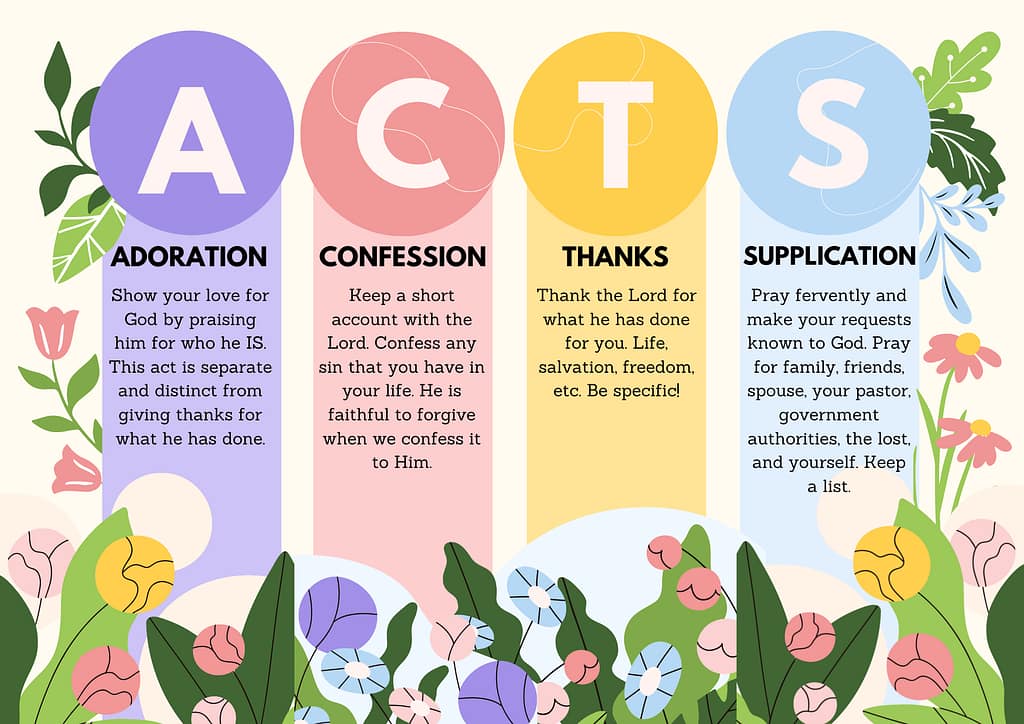
Table of contents
- How to Use This Prayer Study in Your Homeschool
- Free Homeschool Prayer Printable
- A — Adoration: Begin Your Prayer by Telling God Who He Is
- C — Confession: Clearing the Way for Meaningful Prayer
- T — Thanksgiving: Counting What God Has Already Done
- S — Supplication: How to Ask God for What You and Others Need
- What’s Inside the Free Prayer Printable for Kids
- Frequently Asked Questions
- You’ll also love these resources
- About the Author
How to Use This Prayer Study in Your Homeschool
This resource works beautifully as a standalone Bible lesson on prayer, a supplement to your existing Christian homeschool curriculum, or a family devotional you work through together over several days. It’s designed to be accessible for a wide range of ages — younger children (ages 5 and up) can participate through the scripture memory cards and simple discussion questions, while older children and teens can dig into the deeper study, look up the scripture references, and begin developing their own personal prayer habits.
We use it in our homeschool as part of our morning Bible time, but it works equally well for an evening family devotional, a Sunday school class, a co-op Bible study, or a discipleship setting with older kids or friends. Just like a good curriculum organizing system, a simple prayer plan can keep things running smooth.

The free printable includes two resources: a set of KJV scripture memory verse cards on prayer (available as a print-at-home version or a digital version to swipe through on a phone or tablet), and a brief guided study on how to pray with scripture references and simple explanations. Print the verse cards, laminate them if you want them to last, and let your children carry them, display them, or work through them one verse at a time.
Free Homeschool Prayer Printable
Download the KJV scripture memory verse cards and guided prayer study — completely free. Print them for your Bible binder, laminate the cards, or pull up the digital version.
A — Adoration: Begin Your Prayer by Telling God Who He Is
The first step in learning how to pray is learning to begin with God — not with yourself. Adoration means approaching God with worship before you approach Him with requests.
To help your children understand this, try this image. Picture a king seated on his throne during open court, where citizens may bring their petitions before him. Before anyone speaks their request, they must bow. Then they may address the king with his full title and honor. With these simple mannerisms, they acknowledge who he is and the authority he holds.
Be careful for nothing; but in every thing by prayer and supplication with thanksgiving let your requests be made known unto God.
Philippians 4:6
That is how we enter God’s presence in prayer. Now read Revelation 4 together. This entire chapter is a vision of heaven. It describes of the throne of God, the creatures crying “Holy, holy, holy, Lord God Almighty,” the elders casting their crowns. That is where prayer takes us.
Let that image settle in your child’s heart before you teach them another word about prayer. Scripture to use in adoration: Psalm 145:3, Isaiah 6:3, Revelation 4:11, Psalm 96:4. Encourage your children to read one of these verses aloud to God at the beginning of their prayer time. Frame it as an act of worship rather than just recitation.
C — Confession: Clearing the Way for Meaningful Prayer
Before we can pray with a full and open heart, we need to deal with what’s in the way. Unconfessed sin hinders prayer — the Bible is clear about this. Teaching our children this truth early is one of the most important things we can do for their faith.
Confession is not punishment. It is the most relieving part of the entire prayer framework, because it is where guilt is lifted. Any shame is removed, and the relationship with God is restored. None of us shoudl carry that burden, and God doesn’t want us to. Teach your children to ask the Lord to show them their own hearts before they confess. Often we are blind to our own sin.
If we confess our sins, he is faithful and just to forgive us our sins, and to cleanse us from all unrighteousness.”
1 John 1:9
Keep Short Accounts with the Lord
Then confess specifically, repent genuinely, and receive forgiveness. First John 1:9 is the anchor verse for this section. It is a wonderful one for children to memorize. “If we confess our sins, he is faithful and just to forgive us our sins, and to cleanse us from all unrighteousness.”
Other scriptures for confession: Psalm 51:1–2, Psalm 139:23–24, Proverbs 28:13. For younger children, keep it simple — ask them, “Is there anything you did today that you know wasn’t right? Let’s tell God about it and ask Him to help us do better.”
T — Thanksgiving: Counting What God Has Already Done
Thanksgiving is woven throughout every book of the Bible. Because gratitude is not optional for the believer, it is commanded and cultivated. This section of the prayer framework teaches children one of the most transformative habits they can develop. That habit is the practice of noticing and naming what God has given them before asking for anything more.
Continue in prayer, and watch in the same with thanksgiving
Colossians 4:2
For children, this is wonderfully concrete. They can thank God for breakfast, for a sibling, for a sunny day, for a verse they memorized, or for being healthy. As they grow, their gratitude will deepen to include things they don’t yet fully understand. You can hope to one day hear thankfulness for salvation, grace, answered prayers from years past.
Scripture for thanksgiving: Philippians 4:6, Psalm 100:4, 1 Thessalonians 5:18, Colossians 3:17. A simple exercise for younger homeschool students: keep a small gratitude journal alongside the prayer study. Each day before prayer time, write down three things to thank God for. Over a week, you’ll have a list that anchors the thanksgiving portion of every prayer. This will become a beautiful record of God’s faithfulness.
S — Supplication: How to Ask God for What You and Others Need
Supplication is the part most children (and adults) instinctively want to jump to first. The beauty of the ACTS framework is that by the time you arrive here, your heart has already been prepared. You’ve worshipped, you’ve confessed, you’ve given thanks.
Now you are in the right posture to ask. And the Bible makes clear that God delights in our asking. He simply asks that we come to Him with the right heart. Teach your children to pray outward before they pray inward.
Teach Categories to Remember Who to Pray For
Begin supplication with intercession for others, following this order: pray first for those closest to you — your spouse, parents, siblings, and family members.
Next, pray for those who lead and teach you — pastors, homeschool co-op teachers, mentors. Then pray for authority — government leaders, law enforcement, community leaders. Then pray for the lost — those who don’t yet know Christ — and for those who are weak in faith or struggling spiritually. Only after all of this do you bring your own personal requests.
This is not a rule.Iit is a discipline that shapes the heart away from selfishness and toward the kind of love that marks mature faith. Scripture for supplication: Philippians 4:6, Matthew 7:7–8, 1 Timothy 2:1–2, James 5:16. For homeschool families, consider keeping a family prayer list — a notebook or index cards with names and specific requests.
Let your children write the names. Let them cross them off when prayers are answered. There is nothing that builds a child’s faith faster than watching God answer a specific prayer they prayed by name.
What’s Inside the Free Prayer Printable for Kids
To go alongside this Bible study on prayer, I created a two-part free printable resource you can use in your homeschool, family devotional time, or personal study. The free download includes 30 pages of beautiful floral printable pages.
You may be wondering…
What exactly is inside this guide?
The printable contains set of KJV scripture memory verse cards on prayer — designed to be beautiful enough to display, practical enough to carry, and available in both a print-at-home version and a digital version you can swipe through on a phone or iPad.
Two Free Resources in One Download
These are perfect for scripture memorization as part of your homeschool Bible time, or for using as prompts during the corresponding section of your prayer.
The beginning of the printable is a brief guided study on how to pray, with scripture references and simple explanations for each part of the ACTS framework. It’s designed as an introduction — accessible enough for children, meaningful enough for adults — and works well as a Bible study discussion guide for a homeschool family, a co-op class, or a small group. Both printables are completely free. Click below to download them now and add them to your homeschool Bible resources.
Frequently Asked Questions
The most effective method is to model it first and then guide them through a simple framework. The ACTS method — Adoration, Confession, Thanksgiving, Supplication — gives children a concrete structure to follow without making prayer feel rigid or formulaic. Pair it with scripture memory verses on prayer and a family prayer list where they can see God answer specific requests over time.
Children can begin learning to pray as soon as they can speak. Toddlers can repeat simple prayers of thanks. By ages 5–7, most children can follow the basic ACTS framework with guidance. Older children and teens can begin developing independent, scripturally grounded personal prayer habits. This resource works well for ages 5 and up, with parental guidance for younger children.
The Bible gives us extensive, specific instruction on prayer. Key passages include Matthew 6:5–13 (the Lord’s Prayer), Philippians 4:6 (pray with thanksgiving), 1 Timothy 2:1–2 (intercede for others), James 5:16 (confess and pray for one another), and 1 John 1:9 (confess sin and receive forgiveness). This post and the free printable walk through the major biblical categories of prayer using the ACTS framework.
es — the ACTS acronym (Adoration, Confession, Thanksgiving, Supplication) is not a man-made invention but a framework derived directly from how scripture instructs believers to approach God in prayer. It reflects the pattern of the Lord’s Prayer in Matthew 6, the psalms of David, and Paul’s letters. It’s a helpful organizing tool, not a rigid formula.
Absolutely. The free printable study and scripture cards are designed to work for individual family use, homeschool Bible curriculum, co-op classes, Sunday school, and small group discipleship. The guided study format makes it easy to use as a discussion-based lesson for a group of any size.
The scripture memory verse cards use the King James Version (KJV). They are available as a print-at-home printable or a digital version formatted for swiping through on a phone or tablet — perfect for memorization on the go.
Learning how to pray is one of the most important things you will ever teach your children — and one of the most important disciplines you can cultivate in your own life. I hope this study gives your family a meaningful starting point. Download the free KJV scripture cards and guided prayer study below, pin this post to your homeschool resources board, and come back and tell me in the comments how your family is using it. There is nothing I love more than hearing about families praying together.
You’ll also love these resources
- Church Quiet Book for Preschoolers (Free Printable)
- Why I Love My GBC ProClick Binding Machine for Homeschool
- Free Homeschool Unit Study for Science: Building Bridges
Building a faith-filled home education? Explore the Hope Chest Hub.
About the Author

Kim is an adventurous mama of 5 who has been building new skills over 16 years of marriage. Over the past decade, she and her family have built a homestead from the ground up, starting with meat and egg chickens, growing into a large garden, and learning to preserve their harvest.
She taught herself to sew, crochet, and knit 13 years ago through books and early YouTube tutorials, and has been making handmade projects ever since.
Cooking from scratch became a necessity and a passion as her family learned to eat more nutritionally and live more frugally. She tests all of her sourdough and fresh milled flour recipes on the kids to ensure they’re delicious and nutritious.
At Plain Living, Kim shares what she’s actually lived — not theory, but the real skills she’s picked up through years of trial, error, and love for her family and home.
