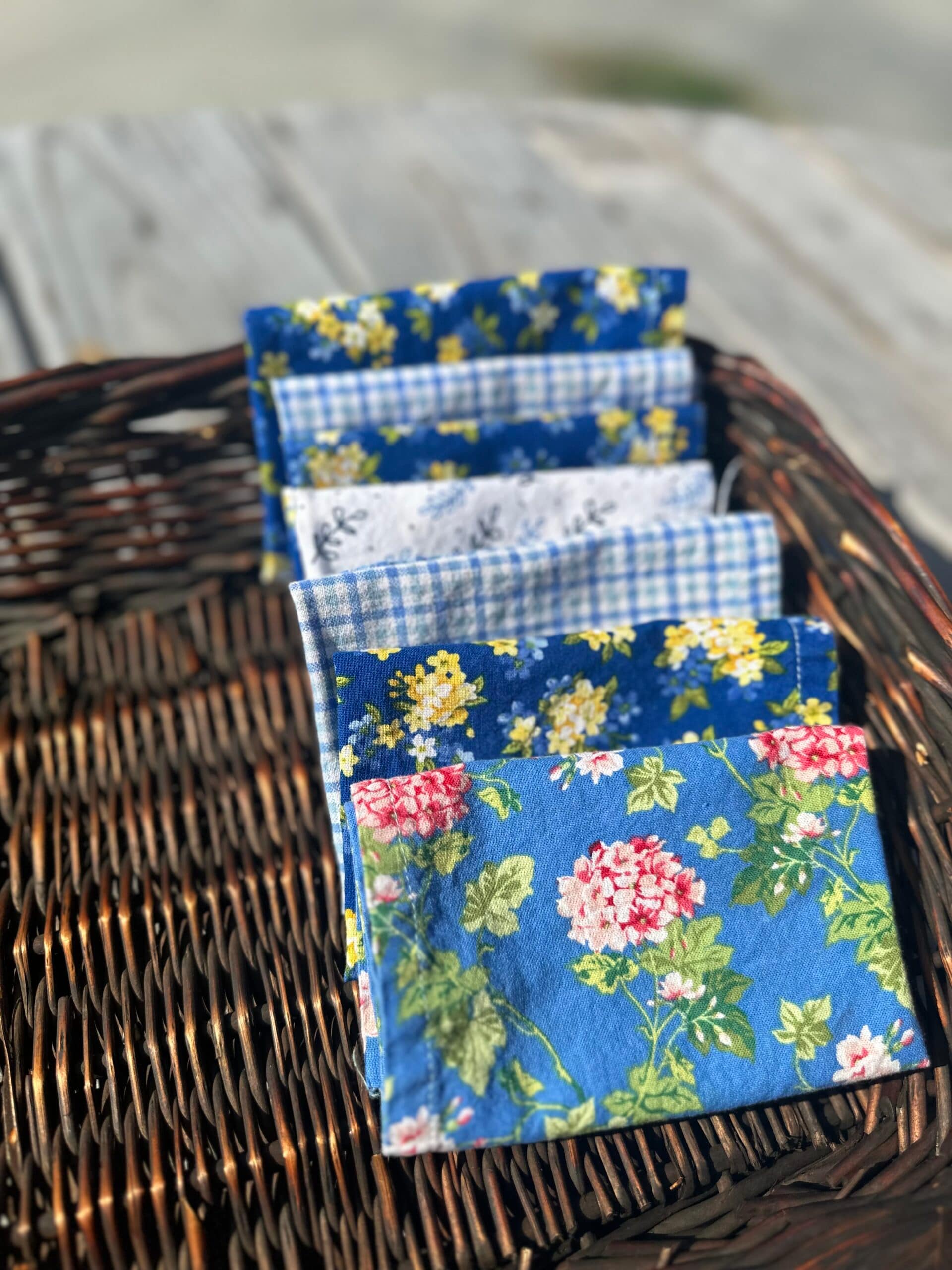
How to Sew Cloth Napkins
Learn how to make cloth napkins with crisp, professional hems and mitered corners using this beginner-friendly step-by-step tutorial. All you need is one yard of fabric, a sewing machine, and an iron. No serger required, no prior experience needed — and the finished result looks like it came from a boutique, not a beginner's sewing room.
Yield: 4 napkins
Equipment
- 1 iron
Materials
- 1 yard quilting cotton
- 1 spool coordinating or contrasting thread
- 1 piece cardstock for my hem guide
Instructions
Step 1: Pre-wash and press your fabric
- Before you cut a single thing, wash and dry your fabric. Cotton and flannel both shrink, and pre-washing now means your finished napkins won't pucker or warp the first time they go through the laundry. Press the fabric smooth with a hot iron before cutting.
Step 2: Cut your squares
- Using your ruler and fabric scissors (or a rotary cutter and mat), cut your fabric into squares at your chosen cut size. Refer to the chart above — your cut size is always larger than your finished size to account for the double-folded hem. Take your time here: square, accurate cuts make every step that follows easier.
Step 3: Make your hem guide
- Cut a strip of cardstock or manila folder about 2 inches wide and 6 inches long. Draw parallel lines at 1/4", 1/2", 3/4", and 1" from one long edge. This is your hem guide — you'll fold fabric over it and press directly on top of it, so it acts as a perfectly accurate template every single time. The free printable hem guide in my guide download saves you this step entirely.
Step 4: Press your first fold
- Place your fabric wrong side up on the ironing board. Fold one edge over your hem guide to the total hem depth — for a 1/4" finished hem, fold up 1/2" total; for a 1/2" finished hem, fold up 1" total. Press firmly with a hot iron and let the fold cool before moving. Repeat on all four sides.
Step 5: Press your second fold
- Open the fabric back out flat. Slide the hem guide in close to the raw edge and fold the raw edge over to the hem line — this tucks the raw edge completely inside the hem so no fraying is possible. Press again. You now have a clean, double-folded hem on all four sides.
Step 6: Mitered corners (optional but recommended)
- Open each corner flat. Fold the corner point in diagonally so the point meets the intersection of your two pressed hem lines. Press that diagonal fold. Then refold both hem edges in on top of each other — the corner will lie flat with a clean diagonal seam and no bunched fabric. This is what separates handmade napkins that look professional from ones that look homemade. It takes an extra two minutes per corner and is absolutely worth it.
Step 7: Clip or pin your hems
- Fold all four pressed hems back into place and secure with clips or pins. Check that your corners are sitting flat before you move to the machine.
Step 8: Sew your hems
- Set your machine to a straight stitch at 2.5–2.8mm length. Sew close to the inner folded edge of the hem on each side, backstitching at the beginning and end. For corners, stop with the needle down, lift the presser foot, pivot the napkin, lower the foot, and continue. Sew all four sides and trim any thread tails.
Step 9: Press the finished napkin
- Give the finished napkin one final press with a hot iron. This step is the difference between a napkin that looks handmade and one that looks like it came from a boutique. Press firmly, let it cool flat, and admire what you just made.
Notes
Fabric quantities by finished size:
- 10" finished napkin → cut 10.5" (1/4" hems) or 11" (1/2" hems) → ~9 per yard
- 11" finished napkin → cut 12" (1/4" hems) or 13" (1/2" hems) → ~6–8 per yard
- 14" finished napkin → cut 15" (1/4" hems) or 16" (1/2" hems) → ~4 per yard
- 16" finished napkin → cut 17" (1/4" hems) or 18" (1/2" hems) → ~2–3 per yard
